
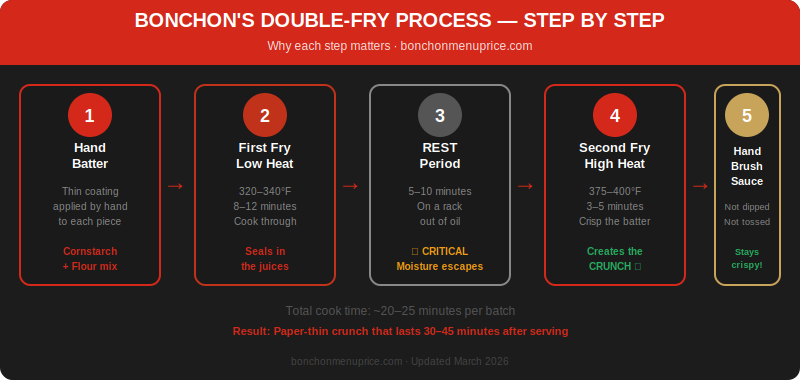
Double-fried chicken is chicken that goes through two separate frying stages instead of one. The first fry begins cooking the chicken and setting its coating. The second fry helps develop a crispier exterior by removing additional surface moisture and changing the texture of the crust.
It’s a technique closely associated with Korean fried chicken, including Bonchon, a restaurant chain known for its crispy wings, drumsticks, and signature sauces.
But why fry chicken twice? Does it really stay crispy longer? And does double-frying make chicken healthier?
The answers are more interesting than simply saying that two rounds of frying produce twice the crunch.
In this guide, we’ll explain how double-frying works, why it can improve crispiness, how Bonchon uses the technique, and what you should know before trying it at home.
What Is Double-Fried Chicken?
Double-fried chicken is fried chicken prepared using two frying stages, sometimes separated by a short resting period.
The method is designed to help the cook manage two important goals:
- Cooking the chicken safely and evenly.
- Developing a crisp, appealing exterior.
During the first fry, the chicken begins cooking while its coating sets.
During the second fry, additional moisture leaves the surface and the coating becomes more browned and crisp.
The exact temperatures, frying times, and resting methods vary between recipes.
Double-frying does not require one universal temperature or a fixed number of minutes. Chicken size, coating thickness, oil temperature, and cooking equipment all affect the process.
How Does Double-Frying Work?
The process is easier to understand when broken into three stages.
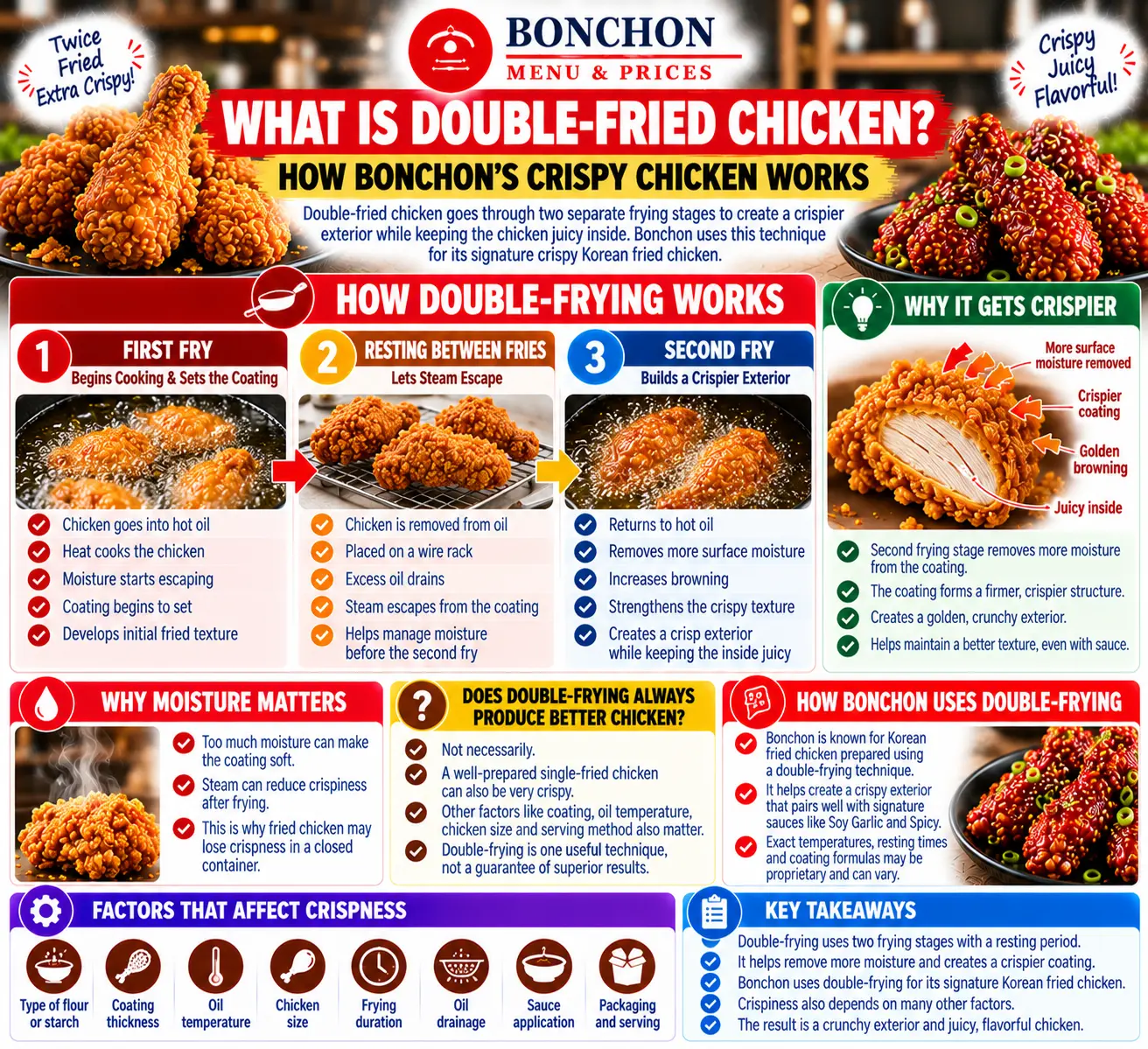
Stage 1: The First Fry
The chicken goes into hot oil for its initial cooking stage.
During this fry:
- Heat moves into the chicken.
- Moisture begins escaping from the surface.
- The coating starts to set.
- The chicken begins developing its fried texture.
Some methods cook the chicken fully during the first fry. Others finish cooking it during the second.
The important point is that the chicken must eventually reach a safe internal temperature, regardless of how the frying stages are divided.
Stage 2: Resting Between Fries
Many double-frying recipes include a resting period.
The chicken is removed from the oil and placed on a wire rack, allowing excess oil to drain and steam to escape.
Resting can help manage moisture before the next frying stage.
However, the length of the rest varies, and not every double-frying method uses the same approach.
A wire rack is often preferable to placing hot chicken directly on a flat plate because air can circulate underneath the pieces.
Stage 3: The Second Fry
The chicken returns to hot oil for another frying stage.
This step can:
- Remove additional moisture from the coating.
- Increase surface browning.
- Strengthen the crispy texture.
- Improve the contrast between the crust and the meat.
Some recipes use hotter oil during the second fry, while others use a different temperature strategy.
The result depends on the complete cooking method, not just the fact that the chicken was fried twice.
Why Does Double-Frying Make Chicken Crispier?
The key is moisture management.
Crisp fried coatings generally develop when enough surface moisture evaporates and the coating forms a firm structure.
During frying, heat causes water in the food and coating to turn into steam.
As moisture escapes, the coating changes texture.
A second frying stage can remove more moisture from the outer layer, helping produce a crisp finish.
Why Moisture Matters
A coating containing too much moisture may feel soft rather than crisp.
Even after frying, steam escaping from the hot chicken can affect the coating.
This is one reason fried food may lose crispness when placed inside a tightly closed container.
Does Double-Frying Always Produce Better Chicken?
Not necessarily.
A well-prepared single-fried chicken recipe can also produce excellent crispness.
Other factors matter, including:
- The type of flour or starch used
- Coating thickness
- Oil temperature
- Chicken size
- Frying duration
- Oil drainage
- Sauce application
- How the chicken is packaged and served
Double-frying is one useful technique, not a guarantee of superior results in every situation.
How Does Bonchon Use Double-Frying?
Bonchon is known for Korean fried chicken prepared using a double-frying approach.
Its chicken is associated with a relatively crisp exterior and flavorful sauces, particularly Soy Garlic and Spicy.
The combination of fried coating and sauce is central to the brand’s identity.
However, Bonchon’s exact commercial frying temperatures, resting times, coating formula, and kitchen procedures should not be assumed from general home recipes.
Those details may be proprietary or vary by product and operational process.
What Makes Bonchon’s Chicken Distinctive?
Three features help explain its appeal.
1. Double-fried preparation
The two-stage frying technique is a major part of Bonchon’s fried chicken identity.
2. A crisp coating
The chicken is known for an exterior that contrasts with the meat inside.
3. Signature sauces
Bonchon’s sauces add flavor to the fried chicken, creating the savory, sweet, and spicy combinations customers associate with the brand.
Bonchon has also promoted a hand-brushed sauce approach. Applying sauce carefully can help control coverage, although the exact method should not be assumed for every menu item or location.
Explore the Bonchon Korean Fried Chicken Menu for the different chicken options.
Double-Fried vs Single-Fried Chicken: What’s the Difference?
Both techniques can produce delicious fried chicken.
The main difference is how the cooking process is divided.
| Feature | Single-Fried Chicken | Double-Fried Chicken |
|---|---|---|
| Frying stages | One | Two |
| Main approach | Cook and crisp during one frying period | Divide cooking and crisping across two stages |
| Resting between fries | Not applicable | Common in many methods |
| Crispiness | Can be very crispy | Can develop additional surface crispness |
| Cooking time | Depends on recipe | Depends on recipe and resting period |
| Oil absorption | Depends on preparation | Depends on preparation |
| Sauce compatibility | Depends on coating and sauce | Depends on coating and sauce |
| Best result | Properly cooked meat with crisp coating | Properly cooked meat with crisp coating |
Neither method guarantees a specific amount of crunch or a fixed cooking time.
Is Korean Fried Chicken Different From American Fried Chicken?
Korean fried chicken and Southern-style American fried chicken often use different approaches to coatings, seasonings, and sauces.
Korean fried chicken is commonly associated with relatively crisp coatings and flavors such as soy garlic or sweet-spicy sauce.
Southern-style fried chicken frequently emphasizes seasoned flour coatings and savory seasoning blends.
However, both traditions include many variations.
Not all Korean fried chicken is double-fried, and not all American fried chicken is single-fried.
The distinction is better understood as a difference in common cooking styles rather than an absolute rule.
Why Does Bonchon Chicken Have Such a Crispy Coating?
Bonchon’s double-frying approach is an important part of the explanation, but it is not the only factor.
Coating composition, preparation, oil temperature, sauce application, and serving conditions all influence the final texture.
Thin Coating vs Thick Coating
A relatively thin coating can create a different bite from a thick, heavily breaded crust.
The final result depends on the ingredients and cooking process.
Bonchon’s exact coating recipe is not publicly established by the information in this guide, so a homemade starch-and-flour mixture should not be presented as its official formula.
Sauce Application Matters
Adding liquid sauce to fried food can soften the crust over time.
A controlled amount of sauce may help preserve some of the coating’s texture compared with completely saturating it.
But no sauce application method guarantees that chicken will remain crispy indefinitely.
For more on the flavors, see Bonchon Sauces Ranked.
Is Double-Fried Chicken Healthier Than Regular Fried Chicken?
Double-fried chicken is not automatically healthier than single-fried chicken.
Although some frying methods may influence oil absorption, frying twice does not guarantee a lower-fat result.
The amount of oil absorbed depends on factors such as:
- Coating ingredients and thickness
- Oil temperature
- Frying duration
- Food moisture
- Draining technique
- Overall preparation
A crispier coating also does not necessarily mean fewer calories.
Does Double-Frying Remove More Oil?
Not reliably.
Oil absorption is a complex process, and different cooking methods can produce different results.
It would be misleading to claim that double-fried chicken always absorbs less oil simply because steam escapes during frying.
What About Calories and Sodium?
Fried chicken’s nutritional profile also depends on portion size, breading, sauces, and sides.
Sweet sauces may contribute sugar, while seasoned coatings and sauces may contribute sodium.
If you are comparing Bonchon menu items for dietary reasons, use current nutrition information rather than assuming that double-frying makes one item healthier.
Read our Bonchon Nutrition Facts Guide for additional context.
How to Make Double-Fried Chicken at Home
You can use the basic double-frying technique in a home kitchen.
The following is a general cooking method inspired by Korean-style fried chicken, not Bonchon’s official recipe.
Because chicken pieces vary considerably in size, use a food thermometer to confirm doneness rather than relying on a fixed frying time.
Ingredients and Equipment
For a basic homemade version, gather:
- Chicken wings or drumsticks
- All-purpose flour
- Cornstarch or another suitable cooking starch
- Salt and preferred seasonings
- Water or another liquid if making a wet batter
- Neutral frying oil suitable for deep-frying
- A heavy, deep pot or appropriate fryer
- A cooking thermometer for oil
- A food thermometer for chicken
- Tongs and a wire cooling rack
Step 1: Prepare the Chicken
Pat the chicken dry with clean paper towels.
Season it according to your recipe.
Avoid washing raw chicken, which can spread bacteria through splashing.
Step 2: Apply the Coating
Coat the chicken using your chosen flour-and-starch mixture or batter.
A lighter coating may produce a different texture from a thick breading.
There is no single flour-to-starch ratio required for double-frying.
Step 3: Heat the Oil Safely
Use a deep, stable pot with enough space to prevent oil from overflowing.
Do not fill the pot excessively.
Monitor the oil temperature with a thermometer and follow a tested recipe suitable for the chicken cut you are preparing.
Never leave hot frying oil unattended.
Step 4: First Fry
Carefully lower a small batch of chicken into the oil.
Avoid overcrowding the pot because adding too much cold food can lower the oil temperature.
Follow the initial frying instructions of a reliable recipe.
The first frying stage may partially or fully cook the chicken, depending on the method.
Step 5: Drain and Rest
Transfer the chicken to a wire rack.
Allow excess oil to drain and steam to escape according to the recipe.
Avoid stacking hot pieces together.
Step 6: Second Fry
Return the chicken to the oil for the second frying stage.
Monitor the coating closely to prevent excessive browning or burning.
The final frying duration depends on the chicken cut, size, and recipe.
Step 7: Check the Internal Temperature
Chicken must reach a minimum safe internal temperature of 165°F (74°C).
Insert a food thermometer into the thickest part of the meat without touching bone.
Do not judge doneness by coating color alone.
Step 8: Drain and Add Sauce
Transfer the cooked chicken to a clean wire rack.
Allow excess oil to drain.
If desired, add your preferred sauce shortly before serving.
For a homemade flavor option, try our Bonchon-Inspired Soy Garlic Sauce Recipe.
Important safety note: Hot oil can cause serious burns. Keep water away from hot oil, use appropriate equipment, and never attempt to extinguish a grease fire with water. Follow a tested recipe and safe deep-frying procedures.
Common Double-Frying Mistakes
Even with two frying stages, chicken can turn out greasy, soggy, overcooked, or unevenly browned.
Here are some common reasons.
1. Overcrowding the Fryer
Adding too many pieces at once lowers the oil temperature and can cause uneven cooking.
Better approach: Fry in manageable batches.
2. Using Oil That Is Too Cool
Oil below the intended cooking temperature can affect browning and coating texture.
Better approach: Monitor the temperature throughout frying.
3. Using Oil That Is Too Hot
Excessive heat may brown the coating before the chicken cooks properly.
Better approach: Follow a tested recipe and check the internal temperature.
4. Making the Coating Too Thick
An excessively thick coating may cook unevenly or produce a texture different from the crisp, lighter style you want.
Better approach: Apply an even coating appropriate for the recipe.
5. Stacking Chicken While Hot
Steam can become trapped between pieces and soften the coating.
Better approach: Drain chicken on a wire rack with space between pieces.
6. Adding Too Much Sauce Too Early
A wet sauce can gradually soften a crispy coating.
Better approach: Sauce the chicken close to serving time when practical.
7. Guessing When the Chicken Is Cooked
Golden-brown coating does not prove that the center has reached a safe temperature.
Better approach: Always verify doneness with a food thermometer.
Does Double-Fried Chicken Stay Crispy Longer?
Double-frying can help create a coating that holds its texture well, but the results depend on storage and serving conditions.
A piece of double-fried chicken may lose crispness if it is:
- Covered tightly while still steaming
- Left in a humid container
- Coated heavily in sauce
- Refrigerated
- Reheated improperly
There is no reliable universal rule that double-fried chicken stays crunchy for a particular number of minutes.
What About Delivery?
Delivery packaging can trap moisture from hot food.
Even well-prepared double-fried chicken may soften during a long delivery trip.
For the best possible texture, eat the chicken reasonably soon after receiving it.
What About Leftovers?
Refrigeration changes the texture of fried coatings.
An oven or air fryer can help restore some crispness during reheating, although the result may not match freshly prepared chicken.
For step-by-step reheating advice, read How to Reheat Bonchon Chicken.
Does Double-Frying Work With Wings, Drumsticks, and Boneless Chicken?
Yes. Double-frying can be used with different chicken cuts.
However, each cut requires appropriate cooking adjustments.
Wings
Wings are relatively small and have a high ratio of skin and coating to meat.
They are commonly used in Korean-style fried chicken recipes.
Explore the Bonchon Wings Menu.
Drumsticks
Drumsticks contain more meat and are usually thicker than wings.
Their size makes internal-temperature checks especially important.
Read our Bonchon Drumsticks Guide.
Boneless Chicken
Boneless pieces can also be double-fried.
However, smaller pieces may cook more quickly than large bone-in cuts, so frying times should be adjusted accordingly.
Chicken Sandwich Fillets
Some fried chicken sandwiches use multi-stage frying methods, but you should not assume that every sandwich follows the same preparation process as a restaurant’s wings.
For more information, see our Bonchon Chicken Sandwich Guide.
Frequently Asked Questions
What does double-fried chicken mean?
Double-fried chicken is chicken cooked in two separate frying stages. The technique can help develop a crisp exterior while allowing the cooking process to be managed in stages.
Why is Bonchon chicken so crispy?
Bonchon is known for double-fried Korean chicken. Its coating, frying process, and sauce application all contribute to the texture associated with the brand.
Is double-fried chicken fried twice?
Yes. The chicken goes through two frying stages, sometimes with a resting period between them.
Does the first fry fully cook the chicken?
Not always. Some recipes fully cook the chicken during the first fry, while others complete cooking during the second. The finished chicken must reach 165°F (74°C).
Is double-fried chicken less greasy?
Not necessarily. Oil absorption depends on the recipe, coating, temperature, and cooking conditions. Double-frying alone does not guarantee less grease.
Is double-fried chicken healthier?
Not automatically. Double-frying is primarily a cooking technique used to influence texture. Calories, fat, sodium, and overall nutrition depend on the complete preparation.
Does double-fried chicken contain less oil?
There is no universal guarantee. Oil absorption varies with ingredients and frying conditions.
Why do some recipes rest chicken between fries?
Resting can allow excess oil to drain and steam to escape before the second frying stage.
Can you double-fry chicken without cornstarch?
Yes. Different recipes use flour, starches, or combinations of coating ingredients. Cornstarch is common in some crispy chicken recipes but is not mandatory.
Is double-fried chicken the same as Korean fried chicken?
No. Double-frying is a cooking method, while Korean fried chicken is a broader food style. Many Korean fried chicken recipes use double-frying, but the terms are not interchangeable.
Does Bonchon brush sauce onto its chicken?
Bonchon has promoted a hand-brushed sauce approach as part of its fried chicken preparation. Exact procedures may differ by menu item, so avoid assuming every product is handled identically.
Does double-fried chicken stay crispy during delivery?
It may retain a crisp texture, but packaging, sauce, steam, and delivery time can all affect the result.
Can you reheat double-fried chicken?
Yes. Reheating in an oven or air fryer can help restore some of the coating’s crispness. Reheat leftovers thoroughly and follow appropriate food-storage guidance.
What is the best oil temperature for double-frying?
There is no single correct temperature for every recipe. The appropriate temperature depends on the chicken cut, coating, equipment, and frying stage. Follow a tested recipe and monitor the oil with a thermometer.
Final Takeaway: Why Double-Frying Matters
Double-frying is one of the techniques that helps explain the crispy texture associated with Bonchon’s Korean fried chicken.
By dividing frying into two stages, cooks can manage cooking and coating development in a way that may produce an especially crisp exterior.
But double-frying is not magic.
The final result still depends on the coating, oil temperature, chicken size, sauce, and serving conditions.
It also does not automatically mean the chicken is healthier, lower in fat, or guaranteed to stay crispy for a fixed amount of time.
The simplest explanation is this: double-frying gives the coating a second opportunity to become crisp.
That combination of technique and flavor is a major part of what makes Korean fried chicken, including Bonchon’s signature chicken, appealing to so many customers.
Official Resources and Related Guides
Official Bonchon Resources
Related BonchonMenuPrice.com Guides
- Bonchon Korean Fried Chicken
- Bonchon Wings
- Bonchon Drumsticks
- Bonchon Chicken Sandwich
- Bonchon Sauces Ranked
- Bonchon Soy Garlic Sauce Recipe
- How to Reheat Bonchon Chicken
- Bonchon Nutrition Facts
Last updated: October 2026
Independent website disclaimer: BonchonMenuPrice.com is an independent informational website and is not affiliated with, sponsored by, or endorsed by Bonchon. This article explains general double-frying principles and is not an official description of Bonchon’s proprietary kitchen procedures. Menu offerings and preparation methods may vary.

BonchonMenuPrice.com is an independent food information site. Our team compiles
prices and nutrition data from Bonchon’s official menus, cross-checks them across
multiple US locations, and updates pages whenever the menu changes.
11 thoughts on “What Is Double-Fried Chicken? How Bonchon’s Crispy Chicken Works”