
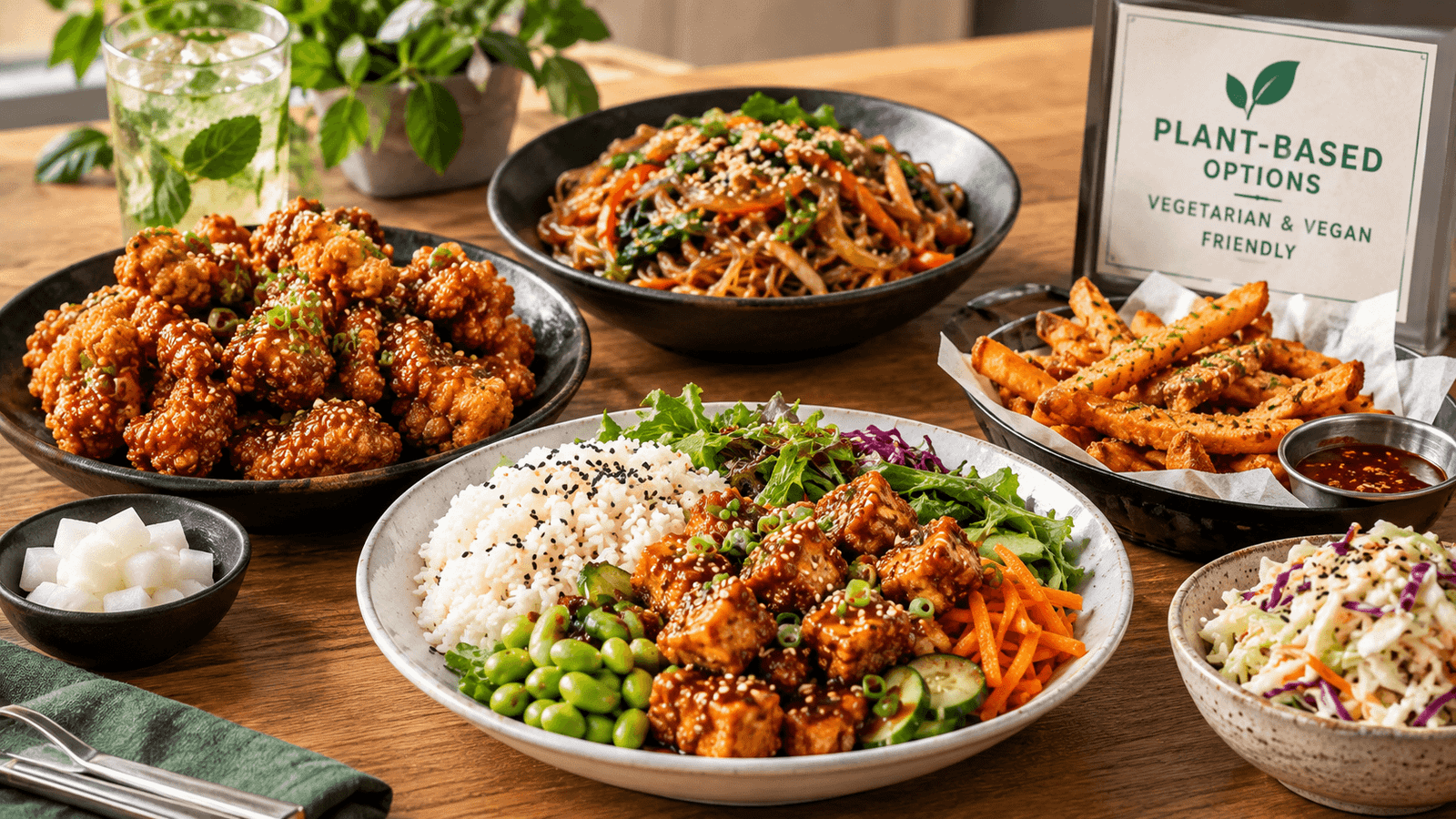
Bonchon is best known for Korean fried chicken, so its vegetarian and vegan choices are more limited than those at restaurants focused on plant-based food. Still, several sides and Korean dishes are worth exploring if you want a meal without meat.
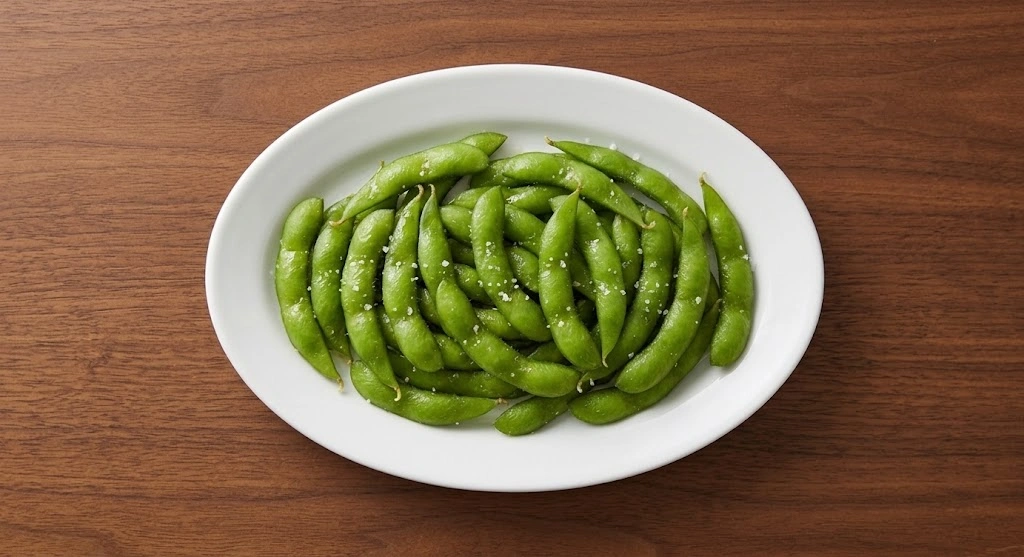
The short answer: Edamame, steamed rice and pickled radish are among the simpler plant-based options to ask about. Bibimbap may be adaptable, but ordering it without egg does not automatically make it vegan. Sauces, broths, marinades and cooking methods can introduce animal-derived ingredients.
This guide explains which Bonchon items may work for vegetarians, which dishes need extra attention, and what to confirm before ordering.
Last reviewed: October 2026
Bonchon Vegetarian and Vegan Options: Quick Guide
The following table is an ordering guide, not a list of certified vegetarian or vegan dishes. Menu availability and preparation may vary by restaurant.
| Menu item | Vegetarian considerations | Vegan considerations |
|---|---|---|
| Edamame | Steamed soybean-based side | Confirm seasoning and preparation |
| Steamed Rice | Rice-based side | Confirm no animal-derived additions |
| Pickled Radish | Pickled vegetable side | Verify brine ingredients |
| Korean Cucumber Salad | Vegetable-based side | Check dressing and seasonings |
| Bibimbap | Plain or tofu configurations may be available | Verify egg, sauce, tofu and preparation |
| Vegetable Potstickers | Vegetable filling may be available locally | Verify wrapper, filling, sauce and cooking |
| Coleslaw | Check the complete dressing | Creamy dressing may contain egg or dairy |
| Korean Street Corn | Described with cheese and mayonnaise | Not vegan as described |
| Seasoned Fries | May include Parmesan cheese | Not vegan if prepared with cheese |
| Japchae | Standard description includes bulgogi beef | Ask whether a meat-free version is possible |
| Tteokbokki | Described with fish cakes and cheese | Not vegetarian or vegan as described |
| Kimchi | Fermented vegetable side | Check for fish sauce or seafood ingredients |
Important: An item that looks plant-based is not necessarily vegan. Restaurant staff should confirm the complete ingredients, sauces and preparation methods before you rely on it for a strict dietary requirement.
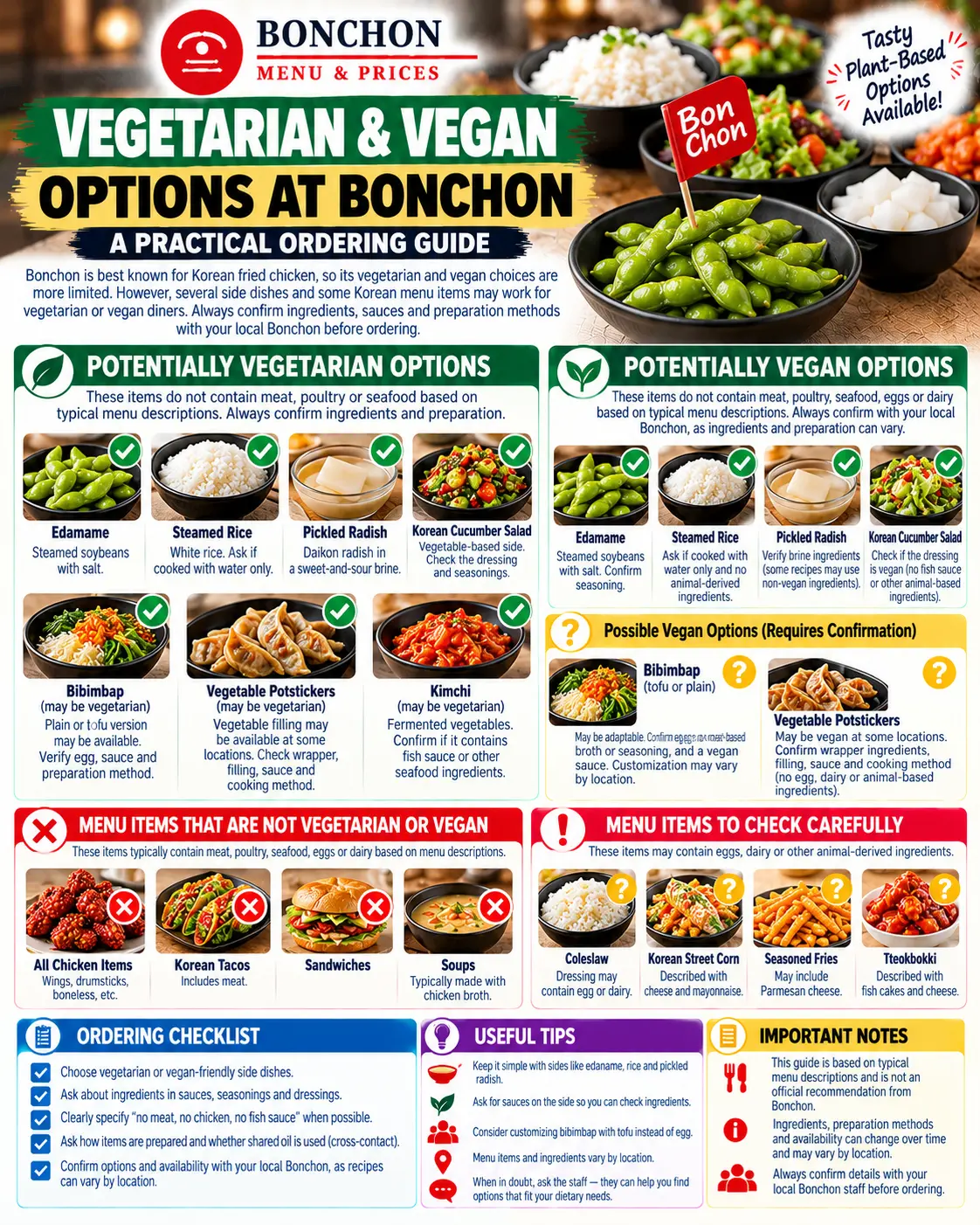
The Simplest Plant-Based Sides to Investigate
Edamame
Bonchon’s edamame is described as steamed soybeans sprinkled with salt.
Because soybeans are plant-based, edamame is one of the more straightforward sides to investigate. However, you should still confirm whether the current preparation includes additional seasonings or ingredients.
Allergen note: Edamame contains soy, a major food allergen.
We have not assigned a calorie or protein total here because nutrition values should be matched to the correct published serving rather than estimated.
Steamed Rice
Steamed white rice is another relatively simple option.
Rice itself is plant-based, but restaurant preparation may involve broth, butter or other additions. If you follow a strict vegan diet, ask whether the rice is cooked with water only and whether any animal-derived ingredients are added.
Pickled Radish
Bonchon’s pickled radish is described as cubed daikon radish in a sweet-and-sour brine.
The main ingredient is a vegetable, but the complete brine recipe should still be verified. Pickled radish may also accompany chicken orders at some locations, depending on the order.
For nutrition context, Bonchon’s reviewed nutrition document lists 15 calories and 35 mg sodium for a 4 oz serving of pickled radish. Those figures describe the published serving, not a guarantee of vegan suitability.
Korean Cucumber Salad
Korean cucumber salad is another vegetable-based item that may be available at participating locations.
The important question is what goes into its dressing and seasoning. Some Korean-style vegetable dishes use fish sauce, shrimp-derived ingredients or other animal products.
Ask the restaurant about its current recipe instead of assuming that a vegetable-based salad is vegan.
Explore more options in our Bonchon Sides Guide.
Can You Order Vegan Bibimbap at Bonchon?
Bibimbap is one of the more promising Bonchon main dishes to investigate because it combines rice, vegetables and different topping options.
However, Bonchon’s standard description includes steamed rice, vegetables, scrambled egg and sauce.
The published menu includes configurations with different toppings, but choosing plain bibimbap or tofu does not automatically make the dish vegan.
What to Ask Before Ordering
If you want to investigate a vegan bibimbap order, ask whether your restaurant can prepare it:
- Without scrambled egg.
- With tofu or without an animal-based protein.
- Without meat-derived broth or seasoning.
- With a sauce confirmed to contain no animal-derived ingredients.
- Using preparation methods that meet your dietary requirements.
Removing the egg is only one step. The sauce, tofu preparation and other components still need verification.
What About Bibimbap Calories and Protein?
Bonchon’s reviewed nutrition document lists 785 calories and 14 g protein for the published plain bibimbap configuration.
However, these numbers should not automatically be applied to a customized vegan order.
Removing egg, changing sauce or adding tofu may change the total calories, protein, sodium and other nutrients. Without an official nutrition entry for the exact modification, those changes cannot be calculated reliably.
For more information about published configurations, see our Bonchon Main Dishes Guide.
Are Bonchon Vegetable Potstickers Vegan?
Vegetable potstickers may be available at participating Bonchon locations, but availability should be checked on the current local menu.
Even when the filling is described as vegetable-based, the complete dish is not automatically vegan.
Before ordering, ask about four things:
- Wrapper: Does it contain egg or another animal-derived ingredient?
- Filling: Does it contain meat stock, fish sauce or seafood seasoning?
- Dipping sauce: Are all ingredients plant-based?
- Cooking: Are the potstickers prepared using shared oil or equipment?
If the restaurant cannot confirm these details, vegetable potstickers should not be treated as a verified vegan choice.
See the Bonchon Starters Guide for more appetizer information.
Vegetarian Options That May Not Be Vegan
Some Bonchon items may appeal to vegetarians who consume dairy or eggs but may not be suitable for vegans.
Korean Street Corn
Bonchon’s Korean Street Corn is described with mozzarella cheese and Kewpie mayonnaise.
These ingredients make the standard preparation unsuitable for a vegan diet.
Vegetarians who consume dairy and eggs may wish to consider it, but should still confirm the complete ingredients and any additional seasonings.
Coleslaw
Coleslaw is a vegetable-based side served with a creamy dressing.
Creamy dressings may contain egg, dairy or other ingredients that are unsuitable for a vegan diet.
Do not assume Bonchon’s coleslaw is vegan without checking the current dressing recipe.
Seasoned Fries
Bonchon’s seasoned fries may include Parmesan cheese.
If cheese is included, the dish is not vegan as described. Some cheeses also use animal-derived rennet, which may matter to vegetarians who avoid it.
Plain French Fries may be a different option, but their seasonings, coatings and frying practices still require confirmation.
Onion Rings and Fried Zucchini
These dishes contain vegetables, but their batters may include egg, milk or other animal-derived ingredients.
Shared frying equipment can also matter to people who avoid contact with animal products.
Ask about both the batter and preparation method before ordering.
Three Bonchon Dishes That Can Be Misleading
1. Japchae
Japchae is traditionally associated with sweet potato glass noodles and vegetables.
However, Bonchon’s standard menu description includes bulgogi beef.
That means the standard preparation should not be assumed vegetarian.
If you want a meat-free version, ask whether the restaurant can omit the beef and whether the sauce, seasoning and cooking process contain any other animal-derived ingredients.
A meat-free modification should not be assumed available at every location.
2. Tteokbokki
Rice cakes themselves can be plant-based, but Bonchon’s Tteokbokki is described with fish cakes and mozzarella cheese.
As described, the standard dish is neither vegetarian nor vegan.
Simply removing visible fish cakes or cheese may not be enough. The sauce or cooking liquid may also contain animal-derived ingredients.
3. Kimchi
Kimchi is made from fermented vegetables, but some recipes include fish sauce, salted shrimp or other seafood-derived seasonings.
For that reason, Bonchon kimchi should not be labeled vegan without confirmation of the current recipe.
This is a useful reminder that a dish can look completely plant-based while still contain seafood-derived ingredients.
What About Bonchon Udon Noodle Soup?
Udon noodles are generally made from wheat, but the noodles alone do not determine whether a soup is vegetarian or vegan.
The broth, sauces and toppings are equally important.
Some udon broths contain fish-derived ingredients or meat stock.
If you are considering Bonchon’s Udon Noodle Soup, ask whether the broth and all selected toppings are suitable for your diet.
Nutrition note: The reviewed plain Udon Noodle Soup entry lists 480 calories and 4,300 mg sodium. This is a published nutrition figure, not evidence that the soup is vegetarian or vegan.
Learn more in the Bonchon Main Dishes Guide.
The Shared Fryer Question
For strict vegetarians and vegans, preparation methods may matter as much as ingredients.
A vegetable-based item can be cooked in equipment that also handles chicken, fish or other animal products.
We have not independently confirmed the fryer arrangements at every Bonchon restaurant, so it would be inaccurate to claim that all locations use shared fryers or separate equipment.
Before ordering fries, onion rings, fried zucchini or vegetable potstickers, ask:
- Is the cooking oil shared with chicken or seafood?
- Are the same utensils used for meat and vegetable items?
- Can the item be prepared separately?
- Are animal-derived ingredients added to the coating, seasoning or sauce?
Different vegetarians and vegans have different preferences regarding shared equipment. The important point is to obtain accurate restaurant-specific information.
For food allergies, shared equipment can also present a separate cross-contact concern. Dietary suitability and allergen safety should not be treated as the same question.
How to Build a Meat-Free Bonchon Meal
If you are visiting Bonchon with friends and want a meal without meat, begin with items that have relatively simple ingredient lists.
Option 1: A Side-Based Meal
Ask about combining steamed rice, edamame and pickled radish.
These are reasonable items to investigate because their main ingredients are plant-based.
However, the restaurant must still confirm their complete preparation.
A side-based meal may also be smaller or less nutritionally balanced than a typical main dish, depending on portions and the items selected.
Option 2: Customized Bibimbap
Ask whether bibimbap can be prepared with tofu, without scrambled egg and with verified plant-based sauces and seasonings.
If the restaurant can confirm every component, it may be a more substantial option with rice, vegetables and a protein source.
Do not assume this modification is offered at every location.
Option 3: A Vegetarian Sharing Order
If you consume dairy or eggs, you might consider asking about Korean Street Corn, coleslaw or other vegetable sides alongside rice.
Check the full ingredients first, particularly sauces, dressings and seafood-derived seasonings.
Price and nutrition note: We have not included a fixed meal total. Bonchon prices vary by restaurant, and customized orders may not match the published nutrition values for standard servings.
For more published nutrition figures, see our Bonchon Nutrition Facts Guide.
How to Order Vegetarian or Vegan Food at Bonchon
Before placing an order, explain exactly which ingredients you avoid.
For example:
“I’m vegan. Can you confirm whether this dish contains meat, fish, shellfish, dairy, egg, honey or animal-derived broth? I’d also like to know how it is prepared.”
For vegetarian orders, explain whether you consume dairy and eggs. Not all vegetarians follow the same restrictions.
If you order through a delivery app, do not assume that adding a note guarantees a modification. Contact the restaurant directly when ingredient verification matters.
If staff cannot confirm an item’s ingredients or preparation, choose another option rather than relying on an assumption.
Frequently Asked Questions
Does Bonchon have vegan options?
Bonchon has several sides with plant-based main ingredients, including edamame, steamed rice and pickled radish. However, their complete vegan suitability must be confirmed with the restaurant.
Does Bonchon have a separate vegetarian menu?
Bonchon primarily focuses on Korean fried chicken. Vegetarian options generally need to be identified from its regular menu and confirmed with the selected restaurant.
Is Bonchon Bibimbap vegetarian?
Plain or tofu configurations may be suitable for some vegetarians, depending on sauces, seasonings and preparation. The standard dish includes scrambled egg, which is acceptable to some vegetarians but not to vegans.
Can Bonchon Bibimbap be made vegan?
Possibly, if the restaurant can omit the egg and verify that the tofu, sauce, seasonings and remaining ingredients are plant-based. This customization is not guaranteed at every location.
Is Bonchon Japchae vegetarian?
The standard menu description includes bulgogi beef. Ask whether a meat-free preparation is possible and whether the remaining ingredients are suitable.
Is Bonchon Kimchi vegan?
Not necessarily. Some kimchi recipes contain fish sauce or other seafood-derived ingredients. Confirm Bonchon’s current recipe before ordering.
Are Bonchon fries vegetarian or vegan?
Their suitability depends on coatings, seasonings and preparation. Seasoned fries containing Parmesan are not vegan as described, while plain fries still require verification.
Is Bonchon Edamame vegan?
Steamed soybeans are plant-based, and Bonchon’s description includes salt. Confirm whether any additional ingredients or preparation methods affect vegan suitability.
Are Bonchon Vegetable Potstickers vegan?
Not automatically. Verify the wrapper, filling, dipping sauce and cooking method, and check whether they are available at your restaurant.
Can a vegan eat a complete meal at Bonchon?
A meal may be possible using verified sides or a customized bibimbap, depending on the restaurant. However, Bonchon is not a restaurant where every vegetable-based dish can automatically be considered vegan.
Official Sources and Research Method
Reviewed: October 2026
This article uses published Bonchon menu descriptions and nutrition information as its primary references.
- Bonchon Official US Menu — menu items, descriptions and ingredients mentioned in standard preparations.
- Bonchon Nutritional Information — official nutrition resources.
- Bonchon Nutrition Facts 2026 PDF — published serving-specific nutrition values.
- Bonchon Restaurant Locator — find a restaurant to confirm local availability and preparation.
Our research distinguishes between three things:
Basic ingredients: Rice, soybeans and vegetables may be plant-based on their own.
Complete restaurant dishes: Sauces, broths, dressings, marinades and toppings may contain animal-derived ingredients.
Preparation methods: Shared fryers, utensils and restaurant-specific substitutions can affect dietary suitability.
We do not certify an item as vegan simply because its name or main ingredient sounds plant-based. We also avoid estimating nutrition totals for modified dishes when no matching official nutrition entry is available.
For related dietary questions, explore our Bonchon Allergen Guide, Is Bonchon Gluten Free? Guide and Bonchon nutrition resources.
Final Takeaway
Bonchon may offer a few workable choices for vegetarians and vegans, but ingredient verification is essential.
Edamame, steamed rice and pickled radish are sensible starting points. Bibimbap may offer more flexibility if a restaurant can accommodate the necessary modifications.
However, dishes such as standard Japchae and Tteokbokki contain animal-derived ingredients as described, while items such as kimchi, fries and vegetable potstickers require closer inspection.
The best approach is to check your selected restaurant’s current menu, ask about every ingredient that matters to your diet and avoid assuming that a vegetable-based item is automatically vegan.
Independent website disclaimer: BonchonMenuPrice.com is an independent informational website and is not affiliated with, sponsored by or endorsed by Bonchon. Ingredients, menus, suppliers and preparation methods may change. This guide does not certify any item as vegan, vegetarian or allergen-free. Confirm current details with your restaurant before ordering.

BonchonMenuPrice.com is an independent food information site. Our team compiles
prices and nutrition data from Bonchon’s official menus, cross-checks them across
multiple US locations, and updates pages whenever the menu changes.
1 thought on “Bonchon Vegetarian & Vegan Options: What You Can Actually Eat (2026)”