
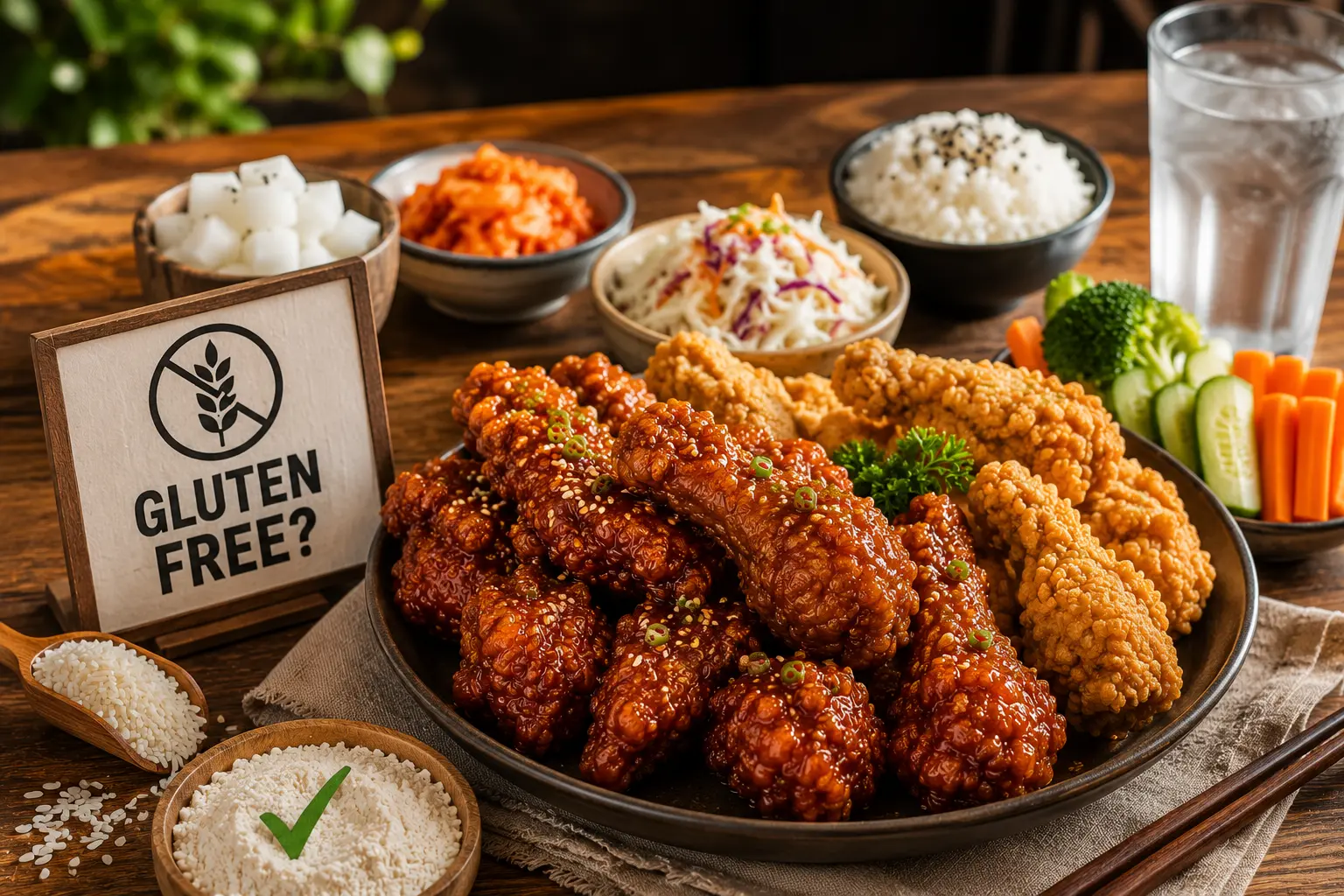
Bonchon has no certified gluten-free menu, and the signature chicken is not gluten-free. Here is exactly what is free of wheat, what is not, and why even the safe items come with a warning.
No. Bonchon is not gluten free, and there is no certified gluten-free menu at any US location. The signature double-fried chicken uses a wheat-based batter, and the sauces are built on soy sauce, which normally contains wheat.
Seven items on the menu contain no wheat as an ingredient: steamed rice, pickled radish, coleslaw, kimchi, Korean cucumber salad, edamame and Korean street corn. Even these are prepared in kitchens with shared equipment, so they are not safe for coeliac disease without confirming preparation at your location.
This page checks every item on Bonchon’s menu against the company’s official allergen and nutrition guide, then explains what that actually means if you are avoiding gluten by choice, by intolerance, or because you have coeliac disease. Those three situations lead to three different answers.
If you want the wider picture across all allergens — dairy, egg, soy, shellfish, nuts — our full Bonchon allergen guide covers the complete chart. This page goes deep on gluten alone.
Why Bonchon’s Chicken Contains Gluten
Two separate ingredients put wheat into almost everything Bonchon serves, and understanding both is what tells you which workarounds are real and which are not.
1. The Batter Is Wheat-Based
Bonchon’s signature crunch comes from a wheat-flour batter. The chicken is coated, fried, rested, then fried a second time the double-fry technique that gives the coating its shatter. That coating is the product. There is no rice-flour or gluten-free version available at US locations, and ordering the chicken “without breading” is not an option on the menu, because the breading is applied before frying rather than at the point of order.
This rules out every item in the Korean fried chicken range — wings, drumsticks, boneless, strips and combos alike.
2. The Sauces Are Soy-Sauce Based
This is the part most people miss. Standard soy sauce is brewed with wheat — usually around 50% wheat to 50% soybeans. It is not a trace contaminant; it is a primary ingredient.
Soy Garlic, Spicy, Yangnyeom and Korean BBQ all build on that base. So even in the hypothetical case of unbreaded chicken, the sauce would reintroduce gluten. Tamari — the wheat-free Japanese soy sauce — is not used at Bonchon.
The practical consequence: there is no combination of chicken and sauce at Bonchon that is free of wheat. Not the Classic Crunch, not sauce on the side, not any cut. The wheat is in both layers.
Every Bonchon Item, Checked for Wheat
Compiled from Bonchon’s official allergen guide. “No wheat listed” means wheat does not appear as an ingredient — it does not mean the item is certified gluten-free or free of cross-contact.
Sides
| Side | Wheat? | Calories | Other allergens |
| Steamed Rice | No wheat listed | 398 | None |
| Pickled Radish | No wheat listed | 15 | None |
| Coleslaw | No wheat listed | 120 | Dairy, Egg |
| Kimchi | No wheat listed | 67 | Soy, Fish |
| Korean Cucumber Salad | No wheat listed | 60 | Sesame |
| Edamame | No wheat listed | 270 | Soy |
| Korean Street Corn | No wheat listed | 345 | Dairy, Egg |
| French Fries | Contains wheat | 360 | — |
| Seasoned Fries | Contains wheat | 430 | Dairy |
| Onion Rings | Contains wheat | 680 | — |
| Sweet Potato Waffle Fries | Contains wheat | 340 | — |
| Fried Zucchini | Contains wheat | 474 | Dairy |
| Seasoned Fried Zucchini | Contains wheat | 532 | Dairy |
Full prices and nutrition for every side are on our Bonchon sides menu page.
Starters
| Starter | Wheat? | Calories | Note |
| Signature Sesame Salad | No wheat listed | 501 | Dressing is soy-based — confirm locally |
| MoPo Corn Dog | Contains wheat | 290 | Breading |
| Sotteok Sotteok | Contains wheat | 219 | Yangnyeom sauce |
| Takoyaki | Contains wheat | 342 | Batter |
| Shrimp Shumai | Contains wheat | 321–470 | Dumpling wrapper |
| Potstickers | Contains wheat | 276–744 | Wrapper + sauce |
| Bao Buns | Contains wheat | 790 | Steamed bun |
| Korean Tacos | Contains wheat | 950–960 | Flour tortilla |
| Bulgogi Fries | Contains wheat | 1,003 | Fries + marinade |
| Seoul Sampler | Contains wheat | — | Multiple components |
Full prices and nutrition for every starter are on our Bonchon appetizers page.
Chicken and Main Dishes
Every item in the chicken range contains wheat — batter and sauce both. Among the main dishes, the rice-based bowls are the closest thing to an option, but only ordered plain: bibimbap without the gochujang sauce and without a fried protein. Japchae uses sweet potato glass noodles, which are naturally wheat-free, but the stir-fry sauce is soy-based. Chicken katsu is panko-breaded. Udon noodles are wheat.
What You Can Actually Eat
Reduced to a practical order, this is what is left.
The realistic gluten-free order at Bonchon: steamed rice ($2.05), pickled radish ($2.05) and edamame ($6.25). That is 683 calories and 36g of protein for $10.35 — a genuine meal, though not the meal you came for.
Add if your location confirms preparation: kimchi ($3.05), Korean cucumber salad ($5.50), coleslaw ($2.05) or Korean street corn ($3.99).
Edamame is the one item that makes this work. At 27g of protein for 270 calories it is the only non-fried, high-protein item on the menu, and it arrives in the pod which means less handling and less opportunity for cross-contact than a plated side.
The Cross-Contamination Problem
Here is where the honest answer diverges from the convenient one.
Bonchon does not operate dedicated gluten-free fryers. Every fried item goes into shared oil that has cooked wheat batter all day. That rules out the fries, which some gluten-free listings incorrectly mark as safe a plain-cut potato is naturally wheat-free, but Bonchon’s fries carry wheat as a listed ingredient and are cooked in shared oil.
Prep surfaces, tongs and gloves are shared too. Kimchi scooped with the same utensils that plated battered chicken is not a controlled environment.
| If you are… | What this means |
| Avoiding gluten by choice | The seven wheat-free items are fine. Order freely from that list. |
| Gluten sensitive (non-coeliac) | The wheat-free sides are usually manageable. Skip anything fried, and ask about utensils. |
| Coeliac | Only steamed rice and edamame come close to safe, and only if staff confirm handling. Many coeliacs will find this restaurant is not worth the risk. |
What To Ask At The Counter
Staff answers vary by location and by shift, so ask specific questions rather than “do you have anything gluten free” — which frequently gets a well-meaning but wrong yes.
- “Is the pickled radish prepared with separate utensils from the chicken?” A specific question gets a specific answer.
- “Is the rice cooked plain, with nothing added?” Some locations season it.
- “Does your kimchi contain soy sauce?” Recipes vary between franchises. Bonchon’s chart lists soy but not wheat; your location may differ.
- “Are the fries cooked in the same oil as the chicken?” The answer is almost always yes, and it is worth hearing it out loud.
- “Can I see your allergen chart?” Locations are required to have it. Reading it yourself beats a verbal answer.
If Bonchon Will Not Work
Korean fried chicken as a category is difficult for gluten avoidance — the wheat batter is what defines the style, and soy-based glazes are near-universal. Some independent Korean restaurants offer rice-flour fried chicken, which is a genuine alternative, but it is rare among the chains.
If you are dining with a group at Bonchon and cannot eat the chicken, the practical move is to order rice, edamame and pickled radish, and treat it as a light meal rather than the main event. Our guide to what to order at Bonchon covers the full menu if you are ordering for others at the same table.
Frequently Asked Questions
Is Bonchon chicken gluten free?
No. Bonchon’s signature chicken uses a wheat-flour batter, and all four signature sauces are built on soy sauce, which normally contains wheat. There is no gluten-free version of the chicken at US locations.
Does Bonchon have a gluten-free menu?
No. Bonchon does not publish a certified gluten-free menu and does not operate dedicated gluten-free fryers. Its official allergen chart identifies which items contain wheat, but the company makes no gluten-free claim for any item.
What can I eat at Bonchon if I am gluten free?
Seven items contain no wheat as an ingredient: steamed rice, pickled radish, coleslaw, kimchi, Korean cucumber salad, edamame and Korean street corn. A practical order is steamed rice, pickled radish and edamame — 683 calories and 36g of protein for about $10.35.
Are Bonchon fries gluten free?
No. Bonchon’s french fries list wheat as an ingredient and are cooked in shared fryer oil alongside battered chicken. The same applies to seasoned fries, onion rings, waffle fries and fried zucchini.
Is Bonchon safe for coeliac disease?
Generally no. Bonchon uses shared fryers, shared prep surfaces and shared utensils, and makes no gluten-free preparation claim. Only steamed rice and edamame come close, and only if staff confirm how they are handled. Many people with coeliac disease will find the risk is not worth it.
Is Bonchon kimchi gluten free?
Bonchon’s allergen chart lists soy and fish for kimchi, but not wheat. Traditional kimchi recipes vary and some include soy sauce, which contains wheat. Since most locations make kimchi in house, confirm at your restaurant rather than assuming.
Can I order Bonchon chicken without the breading?
No. The batter is applied before frying rather than at the point of order, so there is no unbreaded version. Even if there were, the sauces would still contain wheat through soy sauce.
Does soy sauce contain gluten?
Standard soy sauce is brewed with roughly equal parts wheat and soybeans, so yes. Tamari is the wheat-free alternative, but Bonchon does not use it. This is why Bonchon’s sauces contain gluten even though soy sauce is not an obvious wheat product.
Is Bonchon bibimbap gluten free?
Not as served. Bibimbap comes with gochujang sauce, which is typically wheat-containing, and the protein options are battered. Ordered plain — rice and vegetables with no sauce and no fried protein — it is closer, but confirm at your location.
Are Bonchon Korean donuts gluten free?
No. Bonchon’s Korean donuts are a wheat-flour dough, deep-fried in shared oil. Some online listings claim otherwise; those claims are not supported by Bonchon’s allergen chart. Details are on our Bonchon desserts page.
Allergen and nutrition data on this page is taken from Bonchon’s official Nutritional Information guide. Allergen practices vary by location and Bonchon’s US restaurants are independently franchised — always confirm with your local restaurant before ordering. This page is information, not medical advice.

Alex Kim is the pen name of the lead writer and editor at BonchonMenuPrice.com. Every guide is research-based — prices and nutrition details are compiled from official Bonchon menus and cross-checked across multiple US locations, with regular updates whenever the menu changes.
2 thoughts on “Is Bonchon Gluten Free? What You Can Actually Eat (2026)”