
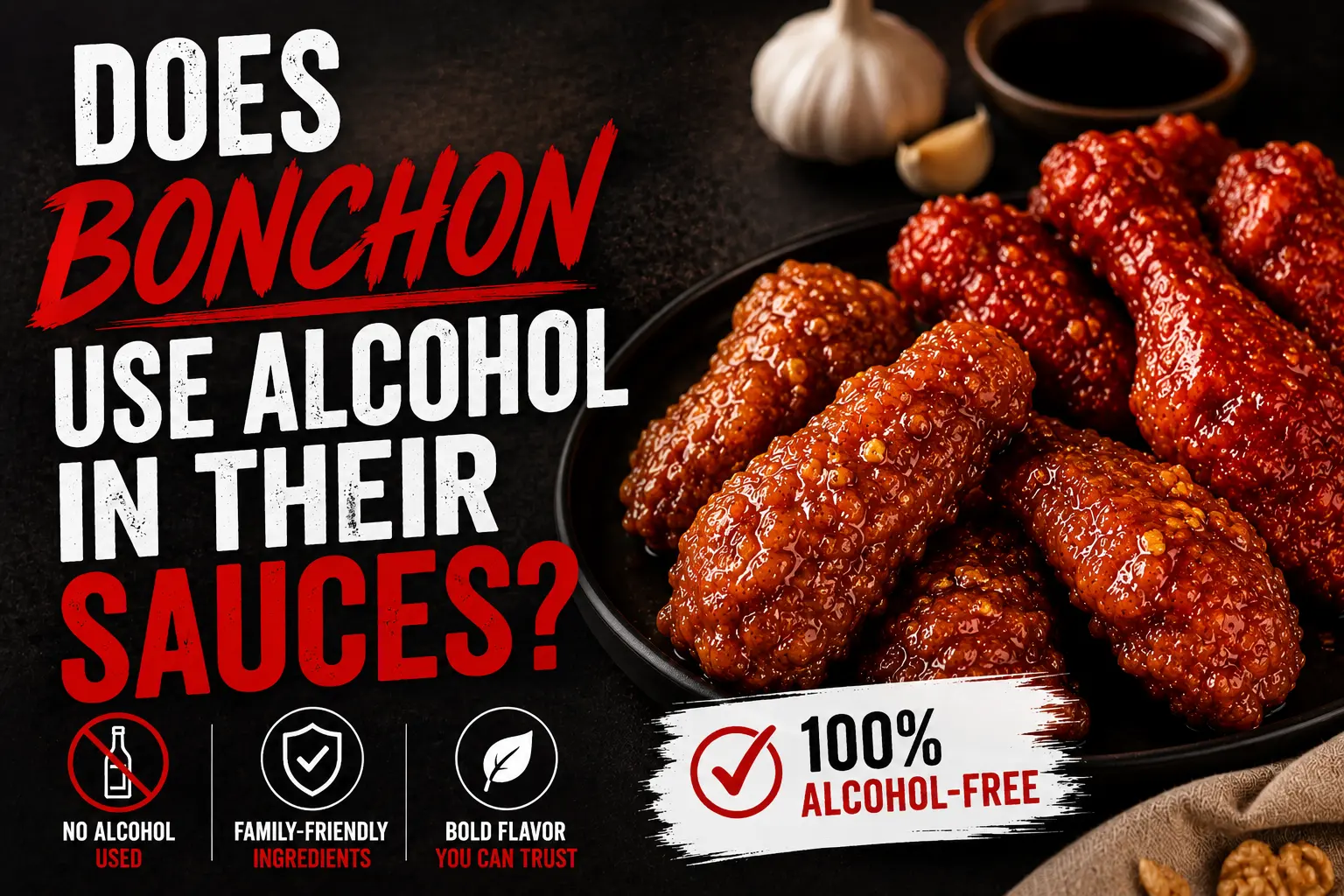
Does Bonchon use alcohol in its sauces? There is a specific reason to investigate at least one Bonchon flavor: in a June 2023 announcement, Bonchon described its Korean BBQ sauce as featuring flavors of garlic and sake, a Japanese rice wine.
That is stronger evidence than simply assuming Korean sauces might contain cooking wine. However, the announcement does not establish whether the current Korean BBQ recipe is unchanged, how much alcohol may remain in the finished sauce, or whether every US restaurant uses an identical formulation.
For Bonchon’s other signature flavors—Soy Garlic, Spicy, Yangnyeom and Classic Crunch—we did not find comparable official statements identifying an alcohol ingredient in the sources reviewed.
The practical answer: Do not assume every Bonchon sauce contains alcohol, but do not assume every sauce is alcohol-free either. Korean BBQ deserves particular attention because of Bonchon’s own historical sake reference.
This guide separates verified company statements from unanswered ingredient questions.
What Bonchon Has Officially Said About Alcohol
On June 26, 2023, Bonchon announced its Korean BBQ sauce and described it as featuring gochujang, rice vinegar and brown sugar, with garlic and sake flavors balanced by sweet pear.
Sake is a Japanese alcoholic rice beverage.
This statement is relevant for anyone avoiding alcohol in food, particularly for religious or personal reasons.
However, three details remain unverified:
- Whether the 2026 Korean BBQ sauce uses the same formulation described in 2023.
- Whether sake is added directly, used in a flavoring ingredient or represented by another formulation.
- How much alcohol, if any, remains in the finished sauce served at a particular restaurant.
The historical reference should not be turned into an unsupported claim about the exact alcohol concentration of today’s sauce.
Official source: Bonchon Debuts New Korean BBQ Sauce — June 26, 2023.
Bonchon Sauce-by-Sauce Alcohol Guide
Bonchon’s current US menu lists five signature chicken flavors: Soy Garlic, Spicy, Korean BBQ, Yangnyeom and Classic Crunch.
| Bonchon flavor | What official sources establish | Alcohol-related conclusion |
|---|---|---|
| Soy Garlic | Listed as a signature flavor | Alcohol content not established by the reviewed sources |
| Spicy | Listed as a signature flavor | Alcohol content not established by the reviewed sources |
| Korean BBQ | Bonchon’s 2023 announcement specifically mentioned sake | Historical alcohol-related ingredient reference; verify current recipe |
| Yangnyeom | Described as sweet and spicy, with garlic and soy notes | Alcohol content not established by the reviewed sources |
| Classic Crunch | Listed as a current chicken flavor | Do not assume alcohol-free without ingredient confirmation |
Important: “Not established” does not mean “alcohol-free.” It means the reviewed sources do not provide enough information to make a reliable determination.
Soy Garlic
Soy Garlic is one of Bonchon’s best-known signature flavors.
Some Korean-style soy sauces and marinades use rice wine, but that culinary tradition is not proof of Bonchon’s particular recipe.
Ask your restaurant whether its current Soy Garlic sauce contains sake, mirin, cooking wine, ethanol-based flavorings or other alcohol-derived ingredients.
Spicy
Bonchon’s Spicy sauce is another signature chicken flavor.
Its spicy taste does not establish whether alcohol is present or absent.
If you avoid alcohol, request the current ingredient information rather than relying on a general description of the flavor.
Korean BBQ
Korean BBQ has the clearest documented reason for further investigation.
Bonchon’s official 2023 announcement explicitly referenced sake in describing the sauce.
If you follow an alcohol-free diet, ask whether the sauce served today contains sake or any other alcohol-based ingredient.
You can also ask whether the company has updated the formulation since its original launch.
Do not rely on cooking temperature or assumptions about evaporation as proof that the finished sauce meets your dietary requirements.
Yangnyeom
Bonchon has described Yangnyeom as a sweet-and-spicy Korean sauce with garlic and soy notes.
That description is useful for understanding its flavor, but it is not a complete ingredient statement.
We cannot confirm its alcohol status from the official descriptions reviewed.
Classic Crunch
Classic Crunch appears alongside Bonchon’s other chicken flavors on the current US menu.
Do not assume that it is alcohol-free simply because it is not described as a traditional sauce.
Ask about the complete seasoning, coating and any flavoring ingredients used in the preparation.
Sake, Mirin and Cooking Wine: What Is the Difference?
These terms sometimes appear in discussions about Korean and Japanese sauces.
Sake is a Japanese alcoholic rice beverage that can also be used in cooking.
Mirin is a sweet rice-based cooking ingredient. Traditional mirin contains alcohol, although products sold under similar names can have different formulations.
Cooking wine is wine intended for culinary use and can contain alcohol.
Rice vinegar is different from rice wine. Vinegar is an acidic ingredient produced through fermentation and should not automatically be treated as the same thing as an alcoholic beverage.
For dietary decisions, the exact product, manufacturing process and relevant religious standards matter.
The presence of the word “rice” in an ingredient name does not tell you whether that ingredient contains alcohol.
Does Cooking Remove All Alcohol?
Not necessarily.
Cooking can reduce alcohol content, but it does not reliably establish that all alcohol has disappeared. The amount remaining depends on factors such as cooking time, temperature, method and the original formulation.
Bonchon does not provide a verified alcohol-retention figure for the sauces discussed here in the sources reviewed.
If your diet requires avoiding alcohol-derived ingredients altogether, do not rely on the assumption that frying or heating makes a sauce acceptable.
Are Bonchon Sauces Halal?
Alcohol is one consideration in halal dining, but it is not the only one.
Other relevant questions may include:
- Whether the chicken comes from a halal-compliant supplier.
- Whether sauces contain alcohol or other ingredients you avoid.
- Whether meat-based ingredients or flavorings are used.
- Whether preparation practices meet your requirements.
- Whether the restaurant or specific ingredients have current halal certification.
A sauce being alcohol-free would not, by itself, make a complete Bonchon meal halal.
Likewise, a third-party listing describing a restaurant as halal does not automatically verify the current formulation of every sauce.
For location-specific guidance, read our Is Bonchon Halal? US Locations & Certification Guide.
How to Verify a Bonchon Sauce Before Ordering
When you contact your local Bonchon, identify the exact sauce and ask these questions:
- Does the current sauce contain sake, mirin, cooking wine or another alcohol-based ingredient?
- Does it contain alcohol-derived flavorings or extracts?
- Can you provide the current ingredient statement or obtain confirmation from your supplier?
- Has the Korean BBQ sauce formulation changed since Bonchon’s 2023 announcement mentioning sake?
- Is the sauce covered by any halal certification, and which organization issued it?
If restaurant staff cannot answer, ask whether they can contact a manager or Bonchon’s customer support.
A nutrition or allergen chart can be useful, but it may not identify every alcohol-related ingredient. An allergen listing is not an alcohol-free certificate.
You can also consult the Official Bonchon Menu and Bonchon Nutritional Information.
What Should You Order If You Avoid Alcohol?
There is no verified basis for ranking Bonchon’s five chicken flavors from “safest” to “least safe” for alcohol avoidance.
If you cannot confirm the sauce ingredients, consider asking whether the restaurant offers an unsauced preparation. Availability may vary, and even unsauced chicken would still require checking its marinade, coating and seasoning.
If the restaurant cannot provide the information you need, choosing a different meal may be the more reliable option.
Frequently Asked Questions
Does Bonchon Korean BBQ sauce contain sake?
Bonchon’s official June 2023 announcement described Korean BBQ sauce with sake among its flavor ingredients. We have not verified whether the current 2026 recipe is identical or how much alcohol, if any, remains in the finished sauce.
Does Bonchon Soy Garlic sauce contain alcohol?
The official sources reviewed do not establish whether the current Soy Garlic sauce contains alcohol. Ask your restaurant for its ingredient information.
Is Bonchon Spicy sauce alcohol-free?
We cannot verify that claim from the reviewed official sources.
Does Bonchon Yangnyeom contain alcohol?
Its official flavor description does not establish the answer. Verify the current ingredients.
Is Bonchon Classic Crunch alcohol-free?
Do not assume so without checking the complete preparation and seasoning ingredients.
Are Bonchon sauces halal-certified?
We have not established a nationwide certification covering every Bonchon US sauce. Ask your specific restaurant for current documentation and the scope of any certification.
Does frying chicken remove alcohol from the sauce?
Not necessarily. Cooking does not guarantee complete alcohol removal, and Bonchon has not provided a verified alcohol-retention figure in the sources reviewed.
Is rice vinegar the same as rice wine?
No. Rice vinegar and rice wine are different ingredients, although both can be made from rice.
Can I ask Bonchon for an ingredient list?
Yes. Contact the restaurant and request the most current information for the exact sauce you plan to order. If staff cannot provide it, ask whether a manager or corporate customer support can help.
Sources and Research Method
Last reviewed: October 21, 2026
Our primary sources include:
- Bonchon Debuts New Korean BBQ Sauce — June 26, 2023 — historical official reference to sake.
- Bonchon Official Menu — current signature chicken flavors and menu availability.
- Bonchon Expands Menu With Fan-Favorite Flavors — October 23, 2024 — Yangnyeom flavor description.
- Bonchon Nutritional Information — published nutrition and allergen information.
Our verification standard: We distinguish between an official historical ingredient description, a current menu listing and a complete ingredient statement. They are not interchangeable.
We do not invent alcohol percentages, assume recipes are unchanged or declare an item halal-certified without supporting documentation.
Final Verdict
Bonchon’s Korean BBQ sauce has a documented historical connection to sake through an official 2023 announcement. That is a meaningful finding for customers who avoid alcohol.
For the other signature flavors, the reviewed official descriptions do not provide enough information to confirm whether they contain alcohol.
Because current formulations and restaurant practices may differ, contact your specific Bonchon location before ordering if alcohol avoidance is important to you.
Related guides: Is Bonchon Halal? · Bonchon Allergen Guide · Bonchon Sauces Ranked · Bonchon Korean Fried Chicken Menu
Independent website disclaimer: BonchonMenuPrice.com is an independent informational website and is not affiliated with, sponsored by or endorsed by Bonchon. Ingredients, recipes and preparation methods may change. This article does not certify any sauce as alcohol-free or halal. Confirm current ingredients and relevant certification with the restaurant before ordering.

BonchonMenuPrice.com is an independent food information site. Our team compiles
prices and nutrition data from Bonchon’s official menus, cross-checks them across
multiple US locations, and updates pages whenever the menu changes.
4 thoughts on “Does Bonchon Use Alcohol in Their Sauces? What Official Sources Say (2026)”