
If you have ever bitten into a piece of Bonchon chicken and wondered why it sounds different from every other fried chicken you have eaten this is why. That thin, papery crack when your teeth break through the batter is the result of a specific cooking technique that most American fried chicken restaurants do not use: double-frying.
This guide explains exactly what double-frying is, why it produces a fundamentally different result from single-frying, how Bonchon applies the technique to every piece of chicken they serve, and why it makes such a practical difference for delivery, leftovers, and the overall eating experience.
What Is Double Fried Chicken?
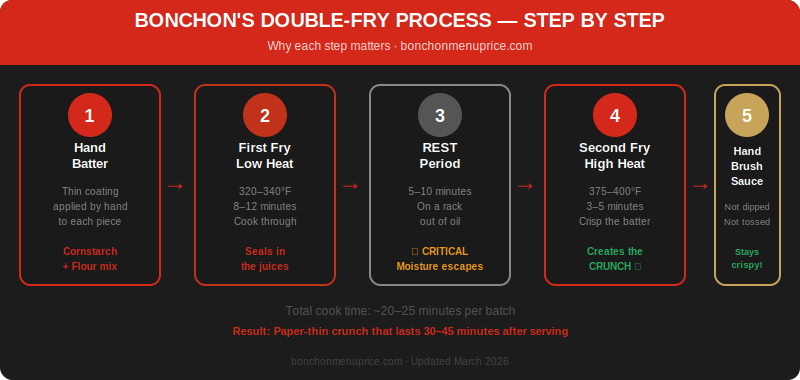
Double-fried chicken is exactly what it sounds like chicken that is fried twice, with a resting period between the two frying sessions. The process has three distinct stages:
First Fry: Low and Slow
The chicken is cooked at a lower temperature (around 320-340°F) for a longer period typically 8-12 minutes depending on the cut. This first fry is not about crispiness. Its job is to cook the chicken all the way through, sealing in the moisture without browning or crisping the exterior aggressively. At the end of the first fry, the chicken looks pale, lightly golden, and somewhat soft.
Rest Period: The Critical Step
After the first fry, the chicken is removed from the oil and allowed to rest for 5-10 minutes. During this rest, moisture from inside the chicken migrates outward through the batter and evaporates. This moisture needs to escape before the second fry begins. If it does not, it turns to steam during the second fry and makes the batter soggy from the inside out.
Second Fry: High Heat Crunch
The chicken goes back into hotter oil (375-400°F) for a shorter period typically 3-5 minutes. This second fry has one job: blasting the batter with high heat to vaporize any remaining surface moisture and create a thin, hard shell. The result is a batter that is almost dehydrated paper-thin, extremely crispy, and structurally separate from the skin underneath.

Why Does Double Frying Work So Well?
To understand why double-frying produces such a superior result, you need to understand what makes fried chicken batter go soggy in the first place.
When you fry chicken, two things happen simultaneously: the batter is trying to crisp up, and moisture from inside the chicken is trying to escape. In a single-fry method, these two processes happen at the same time and temperature.
The moisture escaping through the batter prevents the batter from fully crisping it stays slightly soft because it is constantly being hit with steam from below.
This is why regular fried chicken gets soggy so quickly. The moment you take it out of the oil, the escaping moisture continues to soften the batter from the inside. Within 10-15 minutes, a single-fried chicken piece has noticeably less crunch than it did straight from the fryer.
Double-frying solves this by separating the two processes:
First fry = cook the meat and drive out most moisture.
Rest = let remaining moisture evaporate. Second fry = crisp the now-dry batter at high temperature with minimal moisture interference.
One counterintuitive result: double-fried chicken actually absorbs LESS oil than single-frying. During the high-temperature second fry, the intense heat and moisture vapor escaping from the batter push oil outward rather than drawing it in. This is why Bonchon chicken is less greasy than most American fried chicken.

How Bonchon Applies the Double-Fry Technique
Bonchon did not invent double-frying the technique has roots in Korean, Chinese, and Japanese cooking traditions going back centuries.
What Bonchon did was standardize it, scale it globally, and combine it with a specific batter formula and hand-brushed sauce application.
Step 1: Hand-Battering
Each piece of chicken is individually coated by hand in a thin batter not a thick, heavy coating like American Southern fried chicken. The batter is light, almost translucent when raw.
This thin coating is essential too thick and the double-fry cannot fully dehydrate the interior of the batter before the outside burns.
Step 2: First Fry (320-340°F, 8-12 minutes)
At this temperature, the batter sets without browning aggressively, and the chicken cooks through evenly. The goal here is fully cooked meat, not crispy skin. The chicken comes out pale golden and soft.
Step 3: Rest Period (5-10 minutes)
The chicken rests on a rack for several minutes. This is a non-negotiable step. Rushing or skipping the rest period putting the chicken straight back into the fryer — results in soggy batter. Bonchon’s kitchen protocols include specific rest times for each cut based on size and thickness.
Step 4: Second Fry (375-400°F, 3-5 minutes)
The chicken goes back into hotter oil for a brief second fry. This is where the crunch is created. The high heat rapidly dehydrates the batter surface, creating the signature Bonchon crack. The shorter time at high heat means the meat does not dry out it was already cooked in the first fry.
Step 5: Hand-Brushing (Not Dipping)
After the second fry, the chicken is immediately hand-brushed with sauce. Bonchon does not dip or toss its chicken in sauce every piece is individually brushed. Dipping or tossing would submerge the batter in liquid, immediately destroying the crunch. Hand-brushing applies a thin, even layer to the outside of the batter without soaking through it.
Single vs Double Fry: The Key Differences
| Factor | Single-Fry (Regular) | Double-Fry (Bonchon) |
| Batter Thickness | Usually thick | Thin, almost translucent |
| Crunch Duration | 5–15 minutes | 30–45+ minutes |
| Post-Delivery Quality | Soft, soggy | Mostly intact crunch |
| Reheating Result | Poor — batter deteriorates | Good — air fryer restores |
| Oil Absorption | Higher | Lower — less greasy |
| Sauce Application | Often tossed or dipped | Hand-brushed after second fry |
| Cook Time | 12–15 minutes total | 20–25 minutes total |
Can You Make Double-Fried Chicken at Home?

Yes the double-fry technique is not difficult to execute at home. Here is a simplified version using the same principles as Bonchon:
What You Need
- Chicken pieces — wings or drumsticks work best
- Batter: cornstarch + flour (50/50 ratio) + salt + small amount of baking powder
- Neutral oil (canola or soybean) — enough to submerge the chicken
- Thermometer — the most important tool for double-frying
The Process
- Step 1: Coat chicken lightly in batter — do not build up thick layers
- Step 2: First fry at 325°F for 10-12 min (wings) or 12-15 min (drumsticks) — pale and cooked through
- Step 3: Remove and rest on a wire rack for 8-10 minutes — do NOT skip this step
- Step 4: Second fry at 390°F for 3-4 minutes — watch carefully, it crisps fast
- Step 5: Remove, rest 1 minute, then brush with your chosen sauce immediately
Why cornstarch matters: High cornstarch ratio is key to thin Korean-style batter. Cornstarch does not absorb as much moisture as flour and creates a lighter, crispier shell when fried. Bonchon’s exact formula is proprietary, but the cornstarch-heavy approach is standard across Korean fried chicken chains.
Frequently Asked Questions
What makes Bonchon chicken so crispy?
Bonchon chicken is crispy because of the double-fry technique frying the chicken twice with a rest period between fries. The first fry cooks the meat, the rest lets moisture escape, and the second fry at high heat creates a thin, dehydrated batter shell that stays crispy far longer than single-fried chicken.
Is double fried chicken healthier than regular fried chicken?
Surprisingly, double-fried chicken absorbs less oil than single-fried chicken. The high-heat second fry and moisture vapor escaping from the batter push oil outward rather than drawing it in. Bonchon chicken is less greasy than most American fried chicken despite the extra frying step.
Why does Bonchon chicken stay crispy so long?
The double-fry removes most moisture from the batter before it hardens. Single-fried chicken softens quickly because moisture from inside continues escaping through the batter after frying. In double-fried chicken, most moisture has already been driven out so there is less left to soften the batter afterward.
Why does Bonchon brush sauce instead of toss?
Hand-brushing applies a thin layer of sauce to the outside of the batter without soaking through it. Tossing or dipping would submerge the batter in liquid, immediately destroying the crunch created by the second fry. The hand-brush application is what allows the batter to stay crispy even after sauce is applied.
The Bottom Line
Double-frying is the reason Bonchon tastes the way it does. It is not a gimmick it is a cooking science decision that produces measurably different results: thinner batter, less grease, longer-lasting crunch, and better delivery and reheating performance.
The next time you hear that crack when you bite into a Bonchon wing, you will know exactly what caused it — moisture driven out by the first fry, batter dehydrated by the second, and sauce applied by hand on top of a completely dry, crispy shell. Every step in that process has a reason, and every reason produces a better piece of chicken.
Related: Bonchon chicken sandwich How to Reheat Bonchon Chicken — Keep It Crispy | Bonchon Sauces Ranked: All 5 Options | Bonchon Wings Price & Calories 2026

Alex Kim is the pen name of the lead writer and editor at BonchonMenuPrice.com. Every guide is research-based — prices and nutrition details are compiled from official Bonchon menus and cross-checked across multiple US locations, with regular updates whenever the menu changes.
6 thoughts on “What Is Double-Fried Chicken? Bonchon’s Secret Explained”